
Checking for a Warrant in Carroll
Work from the court's own paper trail first. Carroll posts no city warrant portal, and Iowa Courts Online bills itself as a public case and payment search, not a full active-warrant database. A case or citation number matches far better than a common name. Take the steps in order: pull a docket clue, then confirm it with the office that can actually check current status.
- Collect the full legal name, correct spelling, approximate date of birth, and any complete case or citation number.
- Open Iowa Courts Online, select Carroll County, and search the trial docket or payment route.
- Read appearance, failure-to-appear, warrant issue, return, recall, bond, and next-setting entries without assuming that an old event is still active.
- Call the Carroll County Clerk of Court at 712-792-4327 for the court-file status and the procedure tied to that case.
- Call Carroll Police at 712-792-3536 for city police-service questions or the Sheriff at 712-792-4393 for service, custody, or jail questions.
A routine warrant question never belongs on 911. Before you show up at a building or pay anything, ask the Clerk, the Sheriff, or a lawyer what the Carroll docket requires right now.
Carroll Warrant Search Has No City Roster
Carroll's official city pages give police and traffic contacts but publish no searchable warrant list, no bond window, and no dedicated warrant phone line. That gap shapes how you search. Don't expect the police number to work like a database, and don't read silence from one office as proof that no warrant exists.
Quick answer: “No result” means only that the chosen public search did not return a result. Name variants, the wrong case type, delayed citation posting, confidential material, and city parking matters can all change what appears.
Court notices give different estimates for a new citation to show up: 10 to 14 days in one, 14 to 21 in another. If a recent Carroll citation is missing and timing matters, the Clerk is the right court-record contact.
Carroll Police and Municipal Court
Carroll Police sits at 112 E. 5th Street, Carroll, Iowa 51401-2799. The department's official page says at least two officers are on duty around the clock and lists 712-792-3536 as the nonemergency number. Those are city police facts only. They don't promise that staff will confirm a warrant for you or walk you through a surrender.
Carroll Police Department
Use the nonemergency line for a question about city police service, an arrest contact, or which agency handled an incident. Police may arrest or serve legal process, but a judicial officer issues a warrant.
Iowa District Court
Carroll traffic, misdemeanor, and municipal-infraction matters route through judicial magistrates and other officers within Iowa District Court. The Clerk at 114 E. 6th Street, Suite 5 maintains the county court file.
Iowa's Unified Trial Court Act did away with the old municipal and justice-of-the-peace courts. So "Carroll municipal court" is not a separate city court with its own warrant database.
Carroll Warrant Records Along the Civic Blocks
The Police Department and the county courthouse stand a few blocks apart in central Carroll, but closeness doesn't merge their records. City police work out of an address on East Fifth Street. The Clerk and the Sheriff share 114 E. 6th Street, with the Clerk in Suite 5. Each office answers a different slice of the same problem. The official City of Carroll contact page lays out the city and police routing residents can use.
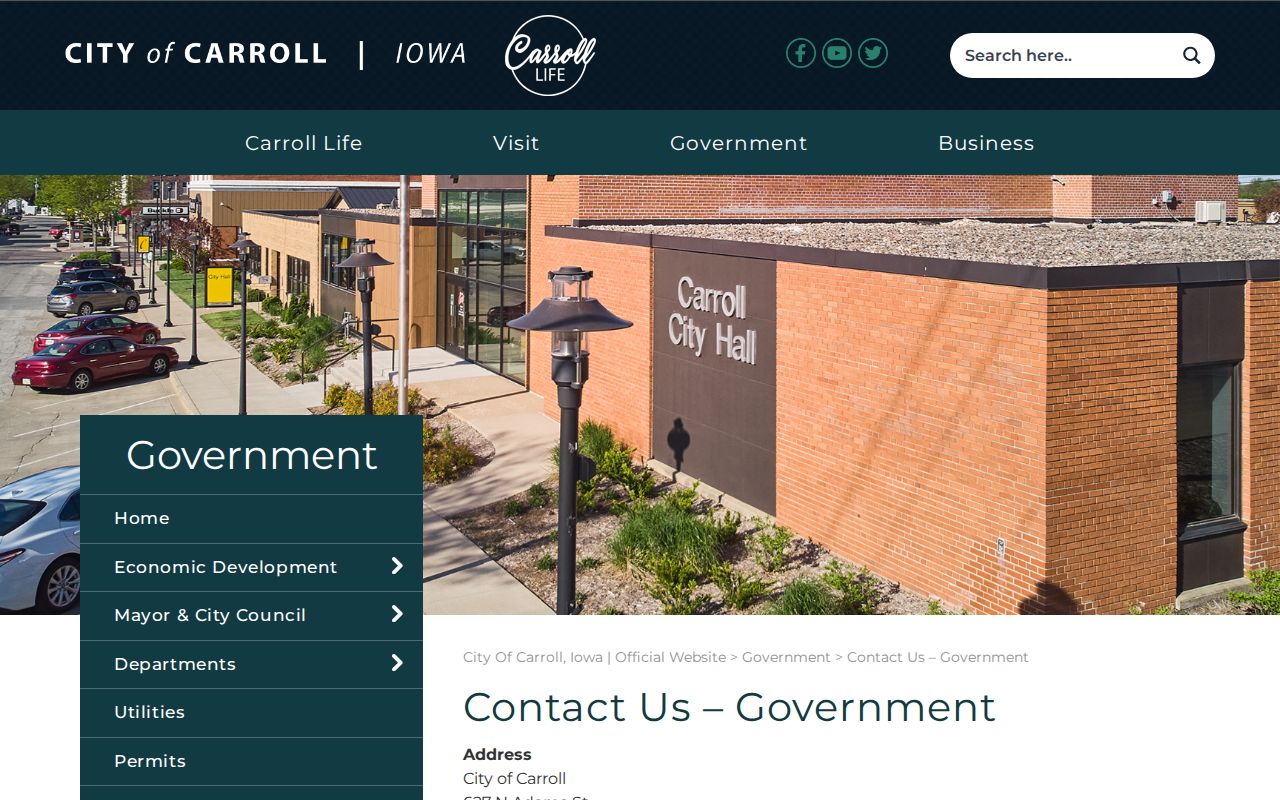
That city contact route finds the police channel, but court-file questions still go to the county Clerk. The Clerk holds the filings, docket information, court dates, payment records, and copies of court files. The Sheriff keeps jail, booking, investigative, service, and return information. Carroll Police handles city police service. Call before you travel, because no official source sets up a city warrant-clearing counter or a walk-in surrender period in Carroll.
Carroll Warrant Types
Iowa's official materials sort warrants by the judicial event and purpose behind them. The label on a docket matters less than the order that issued it and its current status. Ask the Clerk what caused the entry and what the Carroll court now requires.
| Warrant type | How it arises | Carroll route |
|---|---|---|
| Failure-to-appear warrant | A required citation or court appearance is willfully missed. | Iowa District Court docket and Clerk |
| Arrest warrant | A magistrate finds probable cause, or an indictment or information supports issuance. | Issuing court, then serving peace officer |
| Sentencing warrant | A defendant does not appear for sentencing. | Case-specific district court file |
| Search warrant | A judge or magistrate authorizes a search for described evidence. | Different confidentiality and return rules |
Iowa sources use arrest warrant, bench warrant, failure to appear, and warrant of arrest. No Carroll "capias pro fine" process exists here. Don't import terms from other states.
Carroll Traffic Warrants and ODR
The city's traffic-ticket instructions point you either to Iowa Courts Online or to Carroll County Magistrate Court at the courthouse. That local route helps, but a payment screen is not an active-warrant screen. If you missed court, confirm the docket outcome instead of assuming payment alone recalls a warrant. Eligible Carroll traffic citations may qualify for Iowa's Online Dispute Resolution pilot. Its documented options can include a payment plan, a written statement with evidence, County Attorney review, and judicial approval. ODR is not a city police program. It is not a warrant amnesty, and it never promises a recall. Eligibility and the effect of any agreement stay case-specific. City parking violations are a separate exception. They cannot be paid through Iowa Courts Online. Ask the city about the parking obligation while asking the Clerk whether a related district-court matter exists in Carroll.
Inside a Carroll Warrant Record
Carroll publishes no sample active-warrant entry and no local status-code list. For a field guide, use the public docket and Iowa's blank official arrest-warrant form, never a real person's record.
| Case number | The court identifier, which may be a complete 17-character Case ID such as FECR0000000000000 in the public search format. |
|---|---|
| Name and role | The party name and role used to match the correct case. |
| Charge | The offense description or statutory reference, which is not by itself proof of an active warrant. |
| Issue and return | Dates or docket events showing issuance, service, return, or later recall when public. |
| Judge or clerk | The authorized signature or issuance entry shown by the court form. |
| Bail or conditions | Optional case-specific terms. No universal Carroll bond schedule was found. |
Write down the exact case number and wording before you call. Then the Clerk can pull the Carroll file without doing broad research for you.
Carroll Warrant Payment Scam Check
Iowa Judicial Branch warnings make verification part of any safe Carroll warrant search. An urgent call or text demanding prepaid cards, gift cards, cryptocurrency, or instant payment is not the court's process. Hang up. Look up the published Clerk or police number yourself and call that.
Verify first: match the case in the official docket, call the Clerk through the Judicial Branch listing, and use an official payment route only after the case obligation is confirmed.
Paying a court debt is not the same as clearing a warrant. In Carroll, keep your receipt, then confirm the docket reflects the payment and that any warrant order was recalled.
How Carroll Warrants Fit the County System
A Carroll case can begin with city police. The judicial file then moves through Iowa District Court for Carroll County. The Sheriff may serve the warrant or hold custody details. The restricted Iowa On-line Warrants and Articles system connects trained law-enforcement users only, so it is not a public statewide warrant lookup.
Warrant flow: Carroll Police › Iowa District Court and Clerk › Carroll County Sheriff › restricted IOWA law-enforcement system
The Carroll County warrant records overview ties it together. It covers county roles and the courthouse path. Resolution steps are there too, and a city inquiry should use the county layer only long enough to reach the correct custodian.
Carroll Warrant Records Request Choices
Tell the office exactly what you want: a court filing, a city police record, or a Sheriff service or booking record. Say whether you seek inspection, copies, or both. Where you can, give a case number, a document name, a date range, and a preferred existing electronic format. Carroll County does not demand identification or a motive unless another law applies. Complicated court requests may have to be written. Custodians will not research for you. Copy, postage, retrieval, review, redaction, supervision, and programming costs can all apply, and no fixed fee covers a Carroll warrant record. Get an estimate before work begins.
Carroll Warrant Records and Public Access
Access varies by record. The custodian and the case stage matter too. A public Carroll docket may show that an event occurred, while an affidavit, juvenile material, victim information, or part of an active investigation stays confidential or redacted.
Key rules:
Iowa Open Records Law, chapter 22 permits requests for public records while preserving listed confidentiality and investigative exceptions.
Iowa Code section 804.29 protects information filed for an arrest warrant under its conditions until arrest and return or initial appearance.
Iowa Code section 808.13 governs confidentiality of search-warrant applications and affidavits until execution and return under the statute.
Ask for the specific nonconfidential Carroll record, not every warrant. If access is denied or limited, ask the custodian to identify the legal basis.
Resolve a Carroll Warrant Carefully
Once the Clerk confirms a current warrant obligation, ask what event caused it, which judicial officer or court division controls it, and what next setting or filing applies. An attorney can explain your legal choices. The County Attorney prosecutes and participates in some court processes, but its official page says that office cannot assist private citizens. Carroll County runs no safe-surrender event, amnesty, universal recall form, local bond schedule, or public surrender hours. Call the Clerk and the Sheriff first. Never repurpose jail visitation or fingerprint hours as Carroll warrant hours. Payment, court debt, release terms, and warrant recall are distinct steps, and each needs its own confirmation. Confirm before you act.